LarpCheck / verified commerce
Show receipts,
not screenshots.
We read 30 days of real Shopify orders, subtract refunds, strip the fakes, and publish one number you cannot type into existence. Keep it public, keep it private, or sell the store with proof.
Read-only. One scope: read_orders. No order numbers or customer data stored.
The board
Ranked by receipts.
Private when asked.
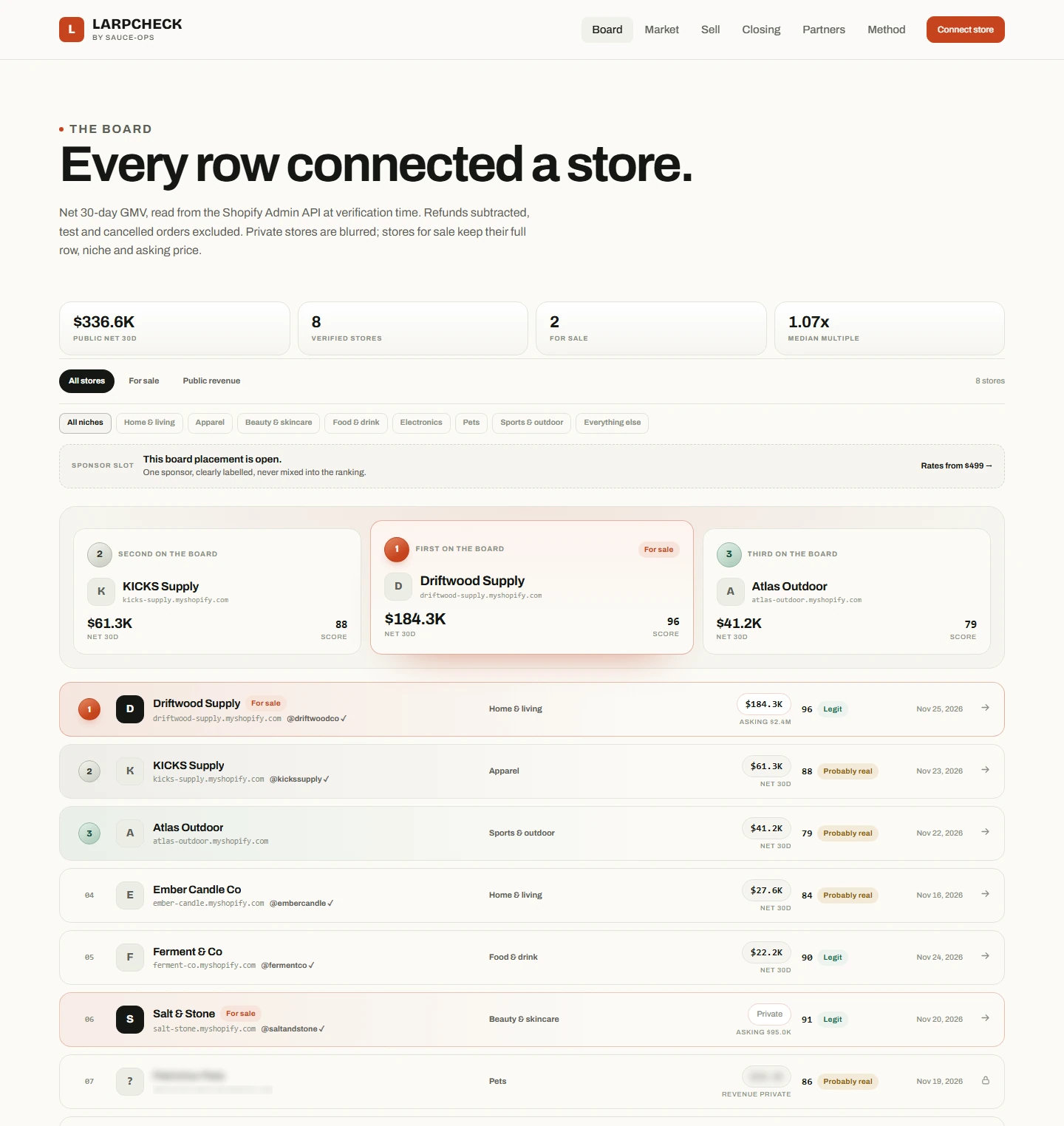
Every row is a store that connected Shopify and passed the same read. Owners who want privacy get blurred. Owners who want to sell keep the full row: niche, verified X and asking price.
Private means blurred
A store that keeps revenue private is blurred on the board: name, domain and number. The score stays visible. No accidental exposure.
Sellers stay legible
A store for sale is never blurred. The row carries a For sale label and the asking price, whether revenue is public or private.
Niche and X on the row
Buyers filter by niche and check the operator behind the store without leaving the board.
The number
Real revenue, straight from the source.
Screenshots are free. LarpCheck reads the raw order window from the Shopify Admin API and publishes one number nobody can fake.
Net, not gross
Gross is for bragging. Every refund is subtracted before your number goes on the board.
Fakes stripped automatically
Test-gateway orders, cancelled orders and draft-order stuffing are filtered before the math runs.
Verified means verified
The badge renders live from the same read. If the number is on LarpCheck, it happened at checkout.
How it works
Verification in three moves.
Read-only, about a minute, nothing to configure on your store. One scope, one read, one number.
Connect your store
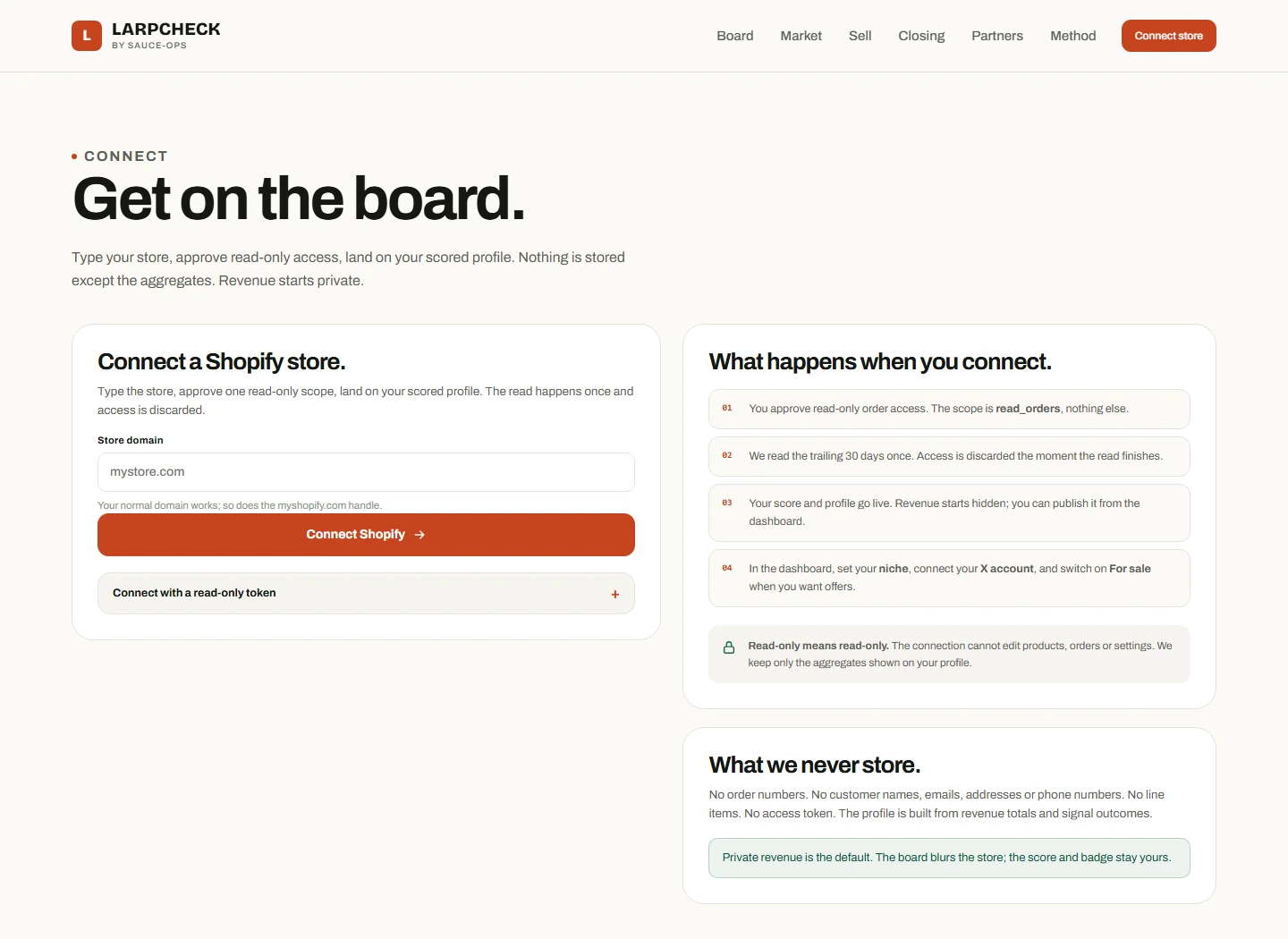
Type your domain, approve read-only order access on Shopify's own screen, or paste a custom-app token. The scope is read_orders, nothing else.
We read 30 days once
Net GMV is gross minus refunds, with test and cancelled orders stripped. Access is discarded when the read finishes.
You choose what is public
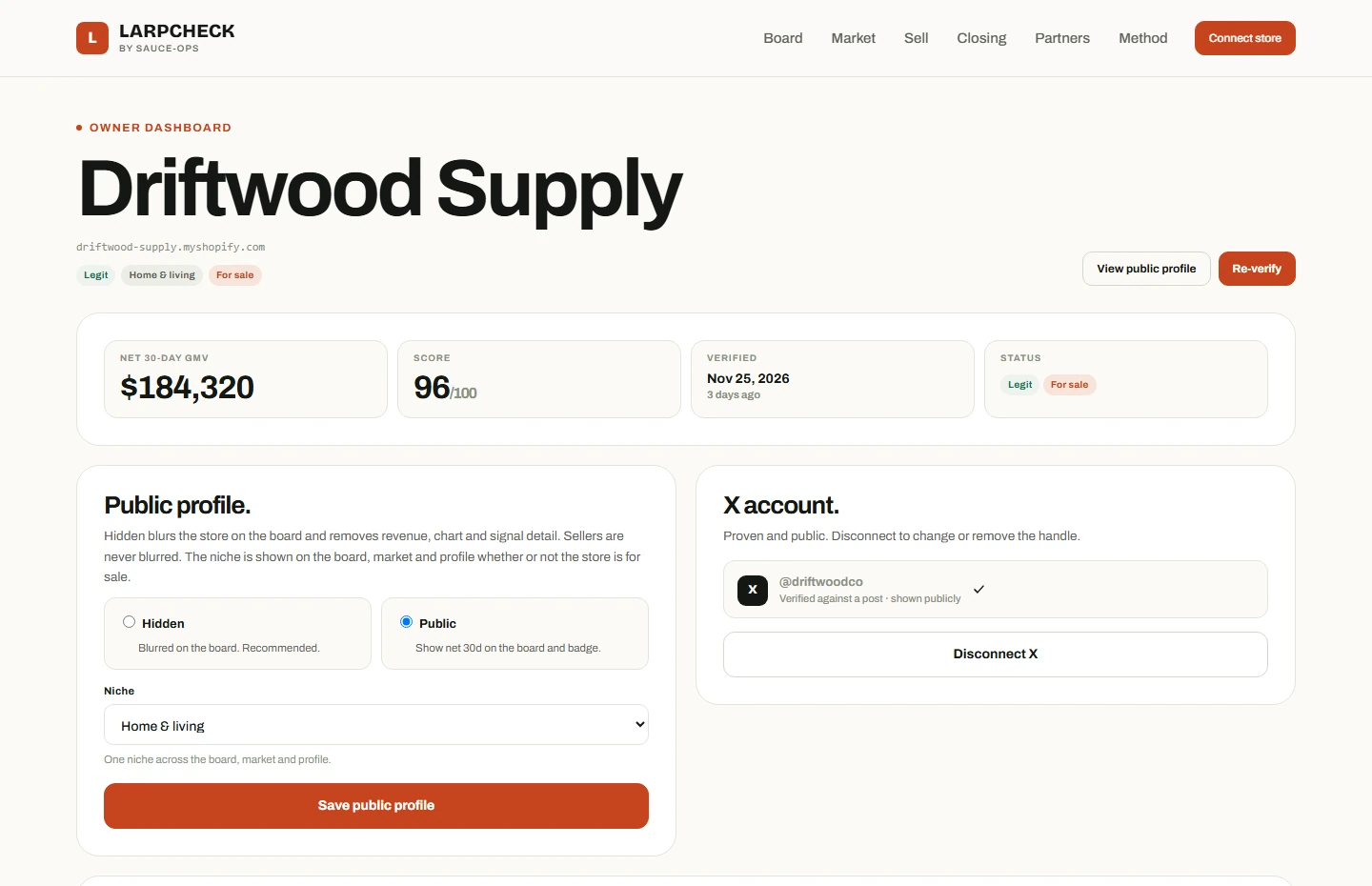
Revenue public or hidden. Niche, X account, and for-sale listing are yours to set. The badge and score stay yours either way.
Niches
Every niche gets the same read.
Home, apparel, beauty, food, electronics, pets, sports. The board filters by niche, and the market uses the same labels so a buyer can go straight to the category they understand.
The deal desk
Three ways to make the market work.
Free to verify, free to list. We earn when a sponsor books a slot, when a deal closes, or when a vetted broker takes a consented lead. The score is never for sale.
3% at close. Split 50/50.
Free to list. Register the deal, get the verified pack, close through escrow. No buyer premium.
$3,600fee on a $120k dealRun the numbers → Broker deskVerified seller leads.
Brokers and acquirers get consented, revenue-verified leads by niche and deal size. No scraped lists.
$500per qualified seller leadSee the partner desk → SponsorshipOwn a board slot.
Six labelled slots above the rows or the market, at one price. They never change a score or a rank.
$499per week, any slotBook a slot →The badge
The argument ender.
A live SVG served from the API. Drop it in your bio, your store footer, or the next reply to a doubter. No verification, no badge.
Rendered live from verified order data on every load.
Sell
Put the receipts
in the listing.
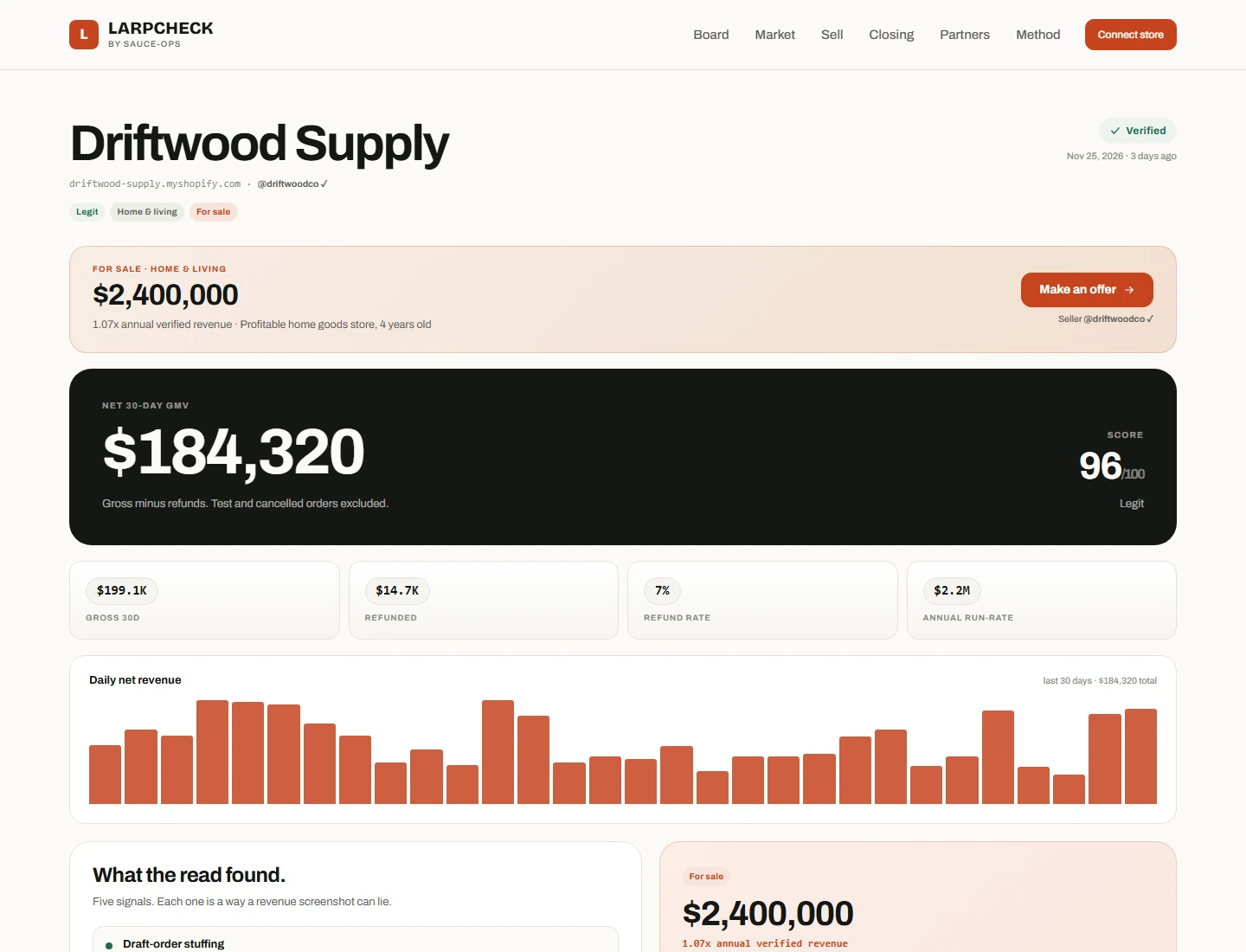
Set the niche, connect X, name the price. Buyers see a verified store instead of a screenshot and a story.
What a seller controls.
- Niche
One category on the board, market and profile. It is independent of whether the store is for sale.
- For sale
A single switch adds the label, the asking price and the offer form. Sellers are never blurred.
- X account
Connect X or verify a post from the dashboard. The handle is public only after you prove control.
Fair questions
Before you connect.
Do you keep access to my store?
No. Whether you use one-click OAuth or a read-only token, access is used for a single read of your order window and then discarded. We store only the revenue aggregates: net, gross, refunds, refund rate, score and signal outcomes.
What counts as revenue?
Net GMV over the trailing 30 days: order totals including shipping and tax, minus refunds. Test orders, cancelled orders and draft orders are excluded or penalised. Nothing is self-reported.
Can someone fake the orders?
They can try. The read comes from Shopify, not a screenshot. Draft-order stuffing, test-mode orders, refund spikes, single-buyer concentration and one-day bursts all reduce the score. Fewer than 10 orders caps the score at 75.
Why is revenue hidden by default?
Because most operators do not want their numbers public. A private store is blurred on the board, but the owner still has the badge, score and profile link. The owner can publish the number from the dashboard at any time.
How does selling work?
Sellers list a store with an asking price, niche and description. Buyers browse verified listings and send an offer through LarpCheck. LarpCheck does not hold funds or transfer the store; the parties close directly. We show the proof, not a guarantee.
The board is public. Your number is your call.
Two minutes with a read-only token. Or keep posting screenshots.
Verify your store